
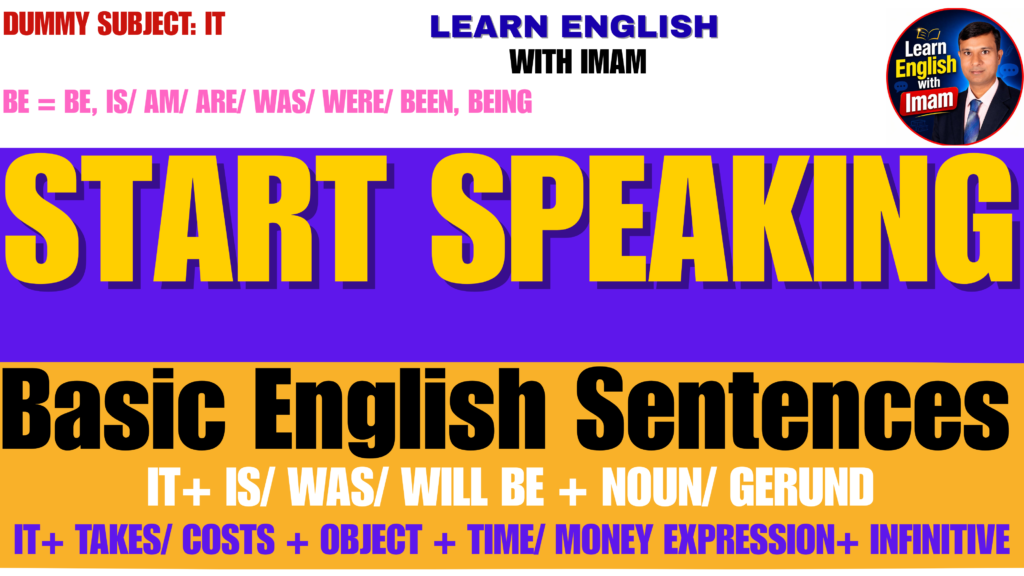
A dummy subject is a subject that does not refer to anything specific but is used to complete the sentence structure.
👉 English sentences must have a subject, so we use “It” when no real subject exists.
1. “It” for Weather Expressions
Used when talking about weather conditions.
Structure:
It + is/was/will be + weather word
- It is raining.
- It was very cold yesterday.
- It will be sunny tomorrow.
- It is windy outside.
- It is snowing outside.
- It is a dusty atmosphere now.
2. “It” for Time Expressions
Used to express time.
Structure:
It + is/was/will be + time
- It is 5 o’clock.
- It is quarter past five.
- It is quarter to five.
- It is half past five.
- It is two minutes past five.
- It is two minutes to five.
- It was midnight.
- It is time to study.
- It is late now.
- It will be late.
3. “It” for Day, Date, Month, Year
Structure:
It + is/was/will be + day/date
- It is Monday.
- It is 10th April.
- It is the 2nd of July today.
- It was November last month.
- It was my birthday yesterday.
- It is the year 2026.
- It will be his death anniversary tomorrow.
4. “It” for Distance
Structure:
It + is/was + distance
- It is 5 km from here.
- It was a long way to the village.
- It is not far from the school.
- How far is it from here?
- It is at a very short distance.
- It is 10 minutes’ distance from my house.
5. “It” for Temperature
Structure:
It + is/was/will be + temperature
- It is 40°C today.
- It was very hot yesterday.
- It is freezing outside.
- It will be cold tomorrow.
- It is cold.
- It is hot.
6. “It” as a Formal Subject (Real Subject at the End)
This is one of the most important uses.
👉 The real subject comes later, and “It” fills the subject position.
(A) With Infinitive (to + verb)
Structure:
It + is/was + adjective + to + verb
- It is easy to learn English.
- It is important to work hard.
- It was difficult to solve the problem.
- It was hard to break the stone.
- It will be easy to cross the river.
(B) With “that” Clause
Structure:
It + is/was/will be + adjective/noun + that/ if + clause
- It is clear that he is honest.
- It is true that she works hard.
- It was surprising that he failed.
- It was false that she loved me.
- It would be good if she came to me.
7. “It” with Verbs (Seem, Appear, Happen)
Structure:
It + seems/appears/happens + that clause
- It seems that he is tired.
- It appears that they are busy.
- It happened that I met him yesterday.
- It felt like they came to congratulate me.
- It seems that they will help Rohit.
8. “It” for Emphasis (Cleft Sentences)
Used to emphasize a specific part of a sentence.
Structure:
It + is/was/will be + emphasized part + that/who + rest
- It is Ali who helped me.
- It is I who love you the most.
- It is she who damaged me a lot.
- It is we who help the needy.
- It was yesterday that I met him.
- It is English that I love.
- It will be he who will stand by you in need.
👉 Focus = Ali / I / she / we / yesterday / English / he
9. “It” as an Object (Introductory Object)
Structure:
Subject + verb + it + adjective + to + verb
- I find it easy to speak English.
- She made it clear to everyone.
- We consider it important to learn grammar.
- I consider it easy to speak English.
- I feel it difficult to write essays.
- She thinks it important to practice daily.
- They believe it helpful to read books.
- We know it necessary to learn vocabulary.
- He judges it wise to speak slowly.
- You see it useful to watch movies.
- They regard it essential to study grammar.
- I realize it challenging to pronounce words.
- We perceive it beneficial to join classes.
10. “It” in Fixed Expressions
These are very common in daily English:
- It is possible.
- It is necessary.
- It is obvious.
- It is a pity.
- It is no use crying.
- It is no good wasting time.
- It is worth learning English.
- It is unjust.
- It is partiality.
11. “It” Referring to Situation/Context
Sometimes “It” refers to a general situation, not a specific noun.
- It is good to help others.
- It was nice meeting you.
- It is hard to believe this story.
- It is difficult to say “no”.
12. “It” in Passive Structures
Structure:
It + is/was + past participle + that clause
- It is said that he is rich.
- It was believed that the earth was flat.
- It is expected that prices will rise.
- It is reported that you were a rich person.
- It is supposed that I will go on teaching.
- It is thought that she will be punished.
13. “It” with “take”
Structure:
It + takes + object + time expression + infinitive
- It takes me a few months to make someone speak the English language.
- It took her half an hour to reach the office today.
- It has taken him one hour today to cook food.
- It will take Sital a year to publish her book.
- How long does it take you to go from the office to your room?
- It was taking us a lot of time to go to any country.
14. “It” with “Cost”
Structure:
It + costs + object + money expression + infinitive
- It costs them nothing to learn the English language.
- It cost me a lot to learn to speak English a long time ago.
- I will cost my student only sincere effort & maintaining consistency to be fluent in English.
- How much did it cost you to send your daughter to study abroad?
15. “It” for Identifying People/Things (Unknown Subject)
- Who is there? → It is me.
- Who knocked? → It was John.
- Who will help you? → It is my parents.